
Stellar is a blockchain network built for moving value.
That may sound a bit too simple, but it is probably the best place to start. Stellar is not only about holding a coin and waiting for the price to move. It is not trying to be a crypto casino, a meme machine, or a giant playground for every possible blockchain idea. Its main job is more down to earth: help money and digital assets move faster, cheaper, and with fewer barriers.
And that problem is still very real.
You can send a photo to someone across the world in a second. You can video call a person on another continent without thinking about it. But moving money across borders can still feel like dealing with old plumbing. Banks, payment processors, currency conversion, waiting times, hidden costs, different local rules. Sometimes it works fine. Sometimes it feels strangely outdated.
Stellar was built for that gap. It gives people, companies, developers, and financial services a public network where value can be issued, sent, received, and exchanged.
The native asset of Stellar is called lumen, usually known by its ticker, XLM. But Stellar and XLM are not the same thing. XLM is the native asset inside the network. Stellar is the network itself.
Stellar is not just “the XLM blockchain”. XLM is the native asset, while Stellar is the network used for payments, issued assets, exchange, and financial connectivity.
The Basic Idea Behind Stellar
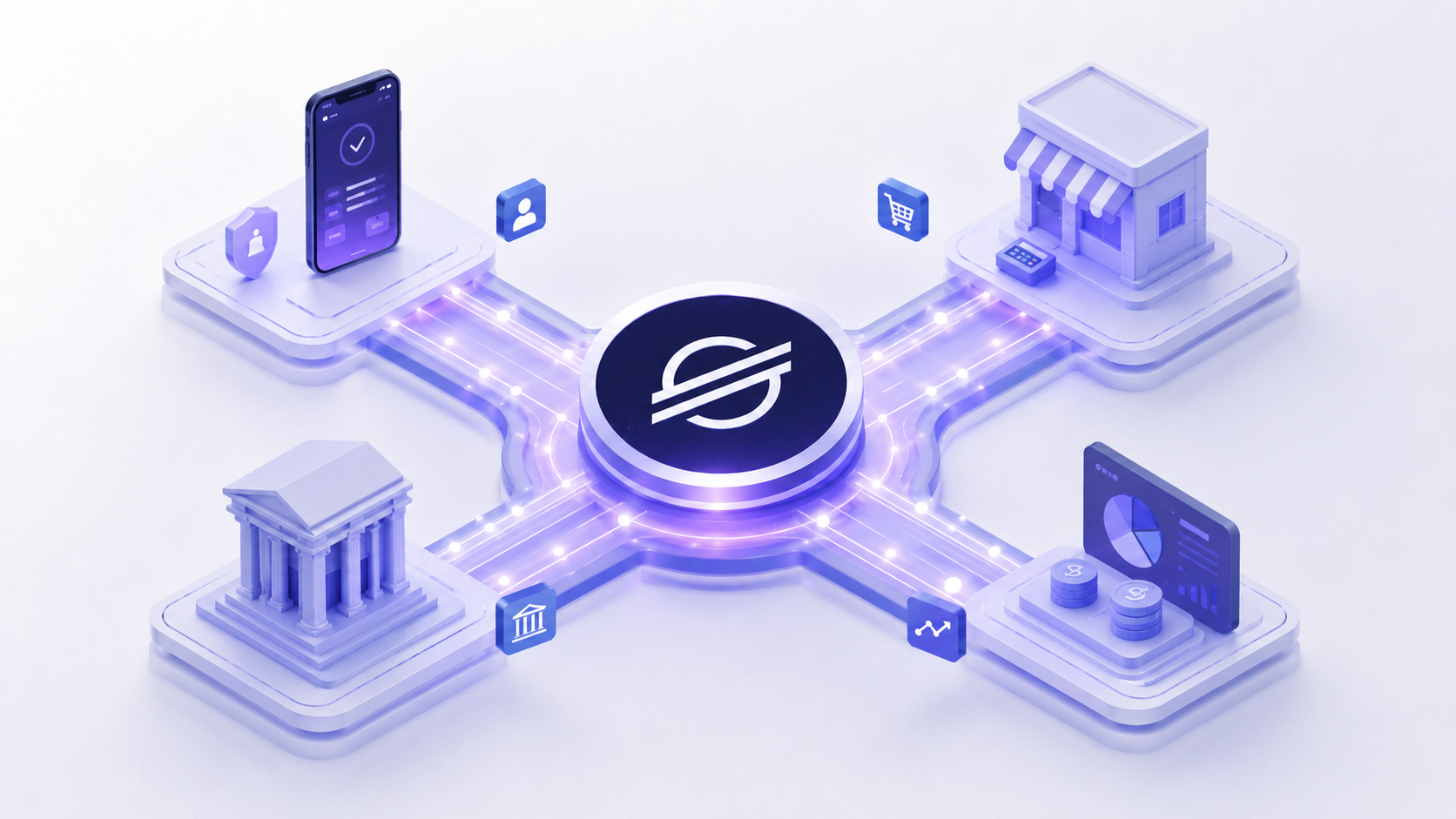
The simple way to picture Stellar is this: it is a shared financial ledger.
The ledger keeps track of accounts, balances, assets, and transactions. When someone sends value through Stellar, the network checks whether the transaction is valid and records it. No traditional bank has to sit in the middle and update a private database for that to happen.
That does not mean Stellar replaces the whole financial world. It does not. But it gives builders a common rail to work with.
A payment app can use Stellar. A fintech company can build on it. A business can issue an asset. A user can send XLM or another Stellar-based asset. Different services can use the same network instead of each one building its own closed payment system from zero.
That is the part that makes Stellar interesting. It is not just a coin. It is infrastructure.
Why Stellar Was Created
Stellar appeared in 2014, at a time when crypto was still mostly seen through the lens of Bitcoin. Bitcoin had already proved that a public digital money network could exist without a central issuer. But there was another question hanging in the air: could blockchain rails also be useful for everyday payments, currency movement, and financial access?
Stellar took that direction.
Its focus was never just “let’s create another coin”. The network was built around payments and value transfer from the start. That is why Stellar is often linked with topics like remittances, stablecoins, tokenized assets, and cross-border settlement.
In normal language, Stellar tries to make this kind of thing easier:
sending value from one country to another without rebuilding the whole payment stack from scratch;
issuing digital assets that can move on a public network instead of staying locked inside one private system;
connecting crypto rails with traditional finance through services that handle deposits, withdrawals, and asset issuance;
giving payment apps and financial tools a cheaper settlement layer for everyday transfers.
That does not mean every Stellar-based project is good. The network gives the rails. The quality of the train still depends on who built it, what asset is being moved, and whether there is real demand behind it.
What Makes Stellar Different?
A lot of blockchains say they are fast. A lot say they are cheap. A lot say they are built for payments.
So why does Stellar stand out at all?
The answer is focus.
Some blockchains try to become everything at once: money, smart contracts, games, NFTs, trading, identity, social apps, corporate tools, and whatever else is popular this cycle. Stellar is more focused. It is mainly built around financial value.
Stellar does not need to win every crypto narrative. Its stronger pitch is narrower: payments, issued assets, settlement, and value movement.
That includes:
- payments;
- issued assets;
- low-cost transfers;
- built-in asset exchange;
- connections to real financial services;
- tools for developers building payment products.
This narrower focus gives Stellar a clearer identity. You do not need to pretend it is the answer to every problem in crypto. It is not. But for moving value, especially between different assets and payment systems, Stellar makes sense.
Stellar Is Not Bitcoin
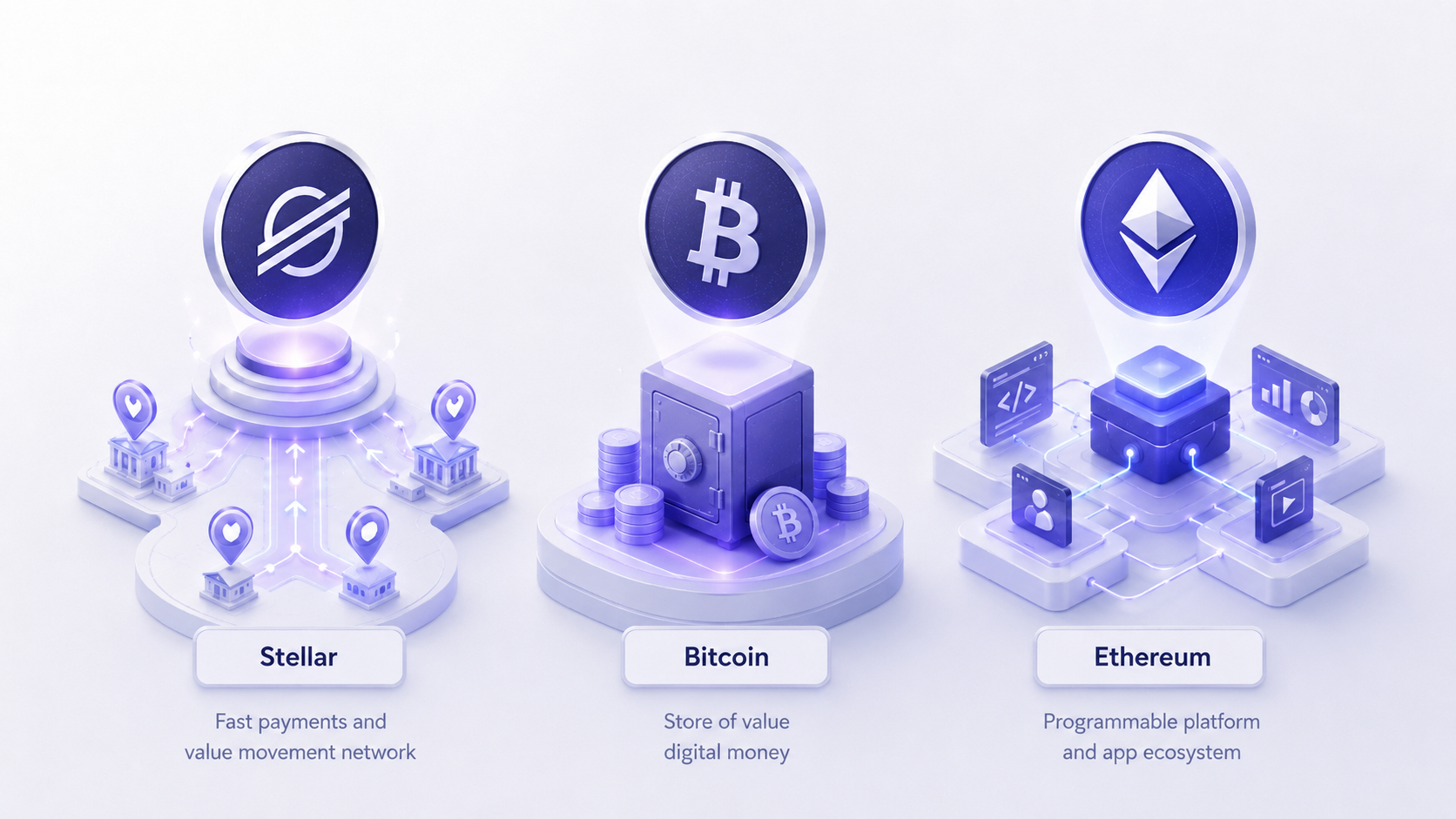
Stellar and Bitcoin are both public blockchain networks, but they are not trying to do the same job.
Bitcoin is mostly about decentralized money. Its core idea is digital scarcity, no central issuer, and a network that is extremely hard to change. It is slow compared with many newer systems, but that is part of its trade-off. Bitcoin is not trying to be a payment processor in the ordinary sense.
Stellar has a different personality.
It is not trying to become digital gold. It is built more around movement than storage. Payments, assets, transfers, exchange, settlement. That is where Stellar lives.
There is also a technical difference. Stellar does not use mining. There are no miners competing with expensive hardware. The network uses the Stellar Consensus Protocol, usually called SCP. The short version: Stellar validators reach agreement without Proof of Work mining.
For an everyday user, the practical result is easy to understand:
- transactions usually settle quickly;
- fees are very small;
- the network does not depend on miners;
- the design is more payment-oriented than Bitcoin’s.
That does not make Stellar “better than Bitcoin”. It makes it different.
Stellar Is Not Ethereum Either
Ethereum is a huge smart contract ecosystem. It is home to DeFi, NFTs, tokens, DAOs, games, experiments, and a lot of things that are hard to explain in one sentence.
Stellar is not that broad.
That can sound like a weakness, but it is not always a weakness. A focused tool can be more practical for a specific job. Stellar’s job is not to host every kind of decentralized application. Its core identity is much closer to payments and asset movement.
Yes, Stellar now has smart contract functionality through Soroban. That gives developers more room to build. But Stellar still feels different from Ethereum. Ethereum is like a large programmable platform. Stellar is closer to a financial rail.
The better question is not “Which blockchain is best?” It is “What do you need the network to do?”
For value movement, Stellar is worth understanding on its own terms.If the answer is “move value quickly and cheaply”, Stellar deserves a look.
Assets On Stellar
One of the main reasons Stellar matters is that it can carry assets other than XLM.
This is a big point. A user may hear about Stellar because of XLM, but the network is not limited to XLM transfers. Assets can be issued on Stellar and then moved through the network.
Those assets might represent different things:
Digital assets tied to currencies or other reference values.
Representations of traditional money that can move on Stellar rails.
Assets used inside apps, services, or settlement flows.
Other issued assets where the issuer, rules, and redemption model matter.
Of course, this does not mean every issued asset is trustworthy. A token is only as good as the issuer, the rules behind it, the liquidity around it, and the ability to redeem or use it.
That is the real-world part people sometimes forget. Blockchain rails can move an asset, but they do not magically make that asset valuable or safe.
Still, Stellar’s native asset features are a major part of its design. It was made for a world where people do not all use one currency, one bank, one app, or one payment system.
What Anchors Do
In the Stellar ecosystem, you will often see the word “anchor”.
An anchor is a company or service that connects Stellar with traditional money systems. For example, an anchor may accept regular money through a bank transfer or another payment method, then issue a matching digital asset on Stellar. Later, the user may be able to redeem that asset back into ordinary money.
So, in plain English, an anchor is a bridge.
And bridges matter a lot.

A blockchain network that cannot connect to the outside world can become a closed island. Stellar was built with the opposite idea in mind. It is supposed to connect with real payment systems, local currencies, businesses, and financial services.
That is why Stellar often comes up in conversations about international payments and remittances. It was not built only for people already deep inside crypto. It was built for value moving between systems.
Built-In Exchange Features
Stellar also has exchange features built into the network.
This means assets on Stellar can be traded or converted through protocol-level tools. In some cases, someone can send one asset and the recipient can receive another, if there is a path and enough liquidity.
That may sound technical, but the idea is very practical.
People do not all want to hold the same thing. One person may hold XLM. Another may want a dollar-based asset. A company may use a local currency token. A payment network has to deal with that mess somehow.
Stellar tries to make that easier by giving assets a way to move and convert inside the same network.
There is still no magic here. If an asset has weak liquidity, bad market depth, or an unreliable issuer, the network cannot fix that by itself. But the design is useful.
What Stellar Is Not
It helps to clear away a few wrong ideas.
Stellar does not work like a normal bank account and does not replace every banking function.
Wallets and payment apps can use Stellar, but Stellar itself is the underlying network.
XLM matters, but the network is broader than market speculation around one asset.
Regulation, liquidity, trust, user experience, and adoption still matter.
Stellar is a public blockchain network focused on moving and issuing value. That is the cleanest description.
Some users care about XLM. Some care about stablecoins. Some care about payments. Some developers care about building apps and services. All of those uses sit on top of the same network.
Why Stellar Still Matters
Stellar still matters because the problem it works on is still real.
Moving money across borders can still be slow. Payment systems are still fragmented. Stablecoins are becoming more common. Tokenized assets are getting more serious. Businesses still look for cheaper and faster settlement.
Stellar is not the loudest project in crypto, and maybe that is part of the point. It does not need to be loud to be useful.
It has a clear job: help value move.
That is why people still pay attention to it after all these years. Not because it promises to reinvent everything overnight, but because it focuses on a very stubborn problem.
Final Thoughts
Stellar is a public blockchain network for payments and digital assets. It was built to make value easier to send, issue, exchange, and settle.
XLM is the native asset of Stellar, but Stellar is bigger than XLM alone. The network can support other assets, connect with financial services, and help developers build payment tools on top of it.
Stellar is infrastructure for value in motion: not just a coin, not just a wallet, and not just another crypto name on a chart.
A network built for moving digital value quickly, cheaply, and with fewer barriers than many traditional systems.

Stellium Editorial Team writes plain-English guides about Stellar, XLM, blockchain payments, and non-custodial wallet basics. The goal is simple: explain crypto infrastructure without turning it into a textbook.